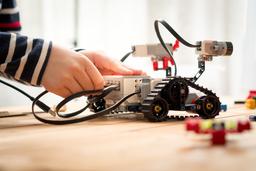
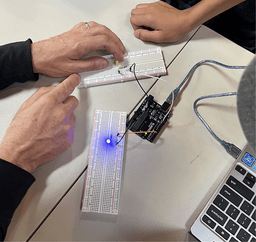
Six science programs are currently listed across two Larchmont studios, with The STEAM Collective offering the bulk of sessions through its NextGen Engineers and Circuit & Code tracks. Creative Corner adds two Friday afternoon STEM blocks, each running roughly 45 minutes, alongside the Collective’s more intensive inventor labs. Schedules appear split evenly between weekday and weekend availability, though specific costs aren’t published here. All upcoming sessions are listed below; filter by age band once available to narrow your options.
Pre-Algebra Honors prepares students for the rigors of algebra and also explores problem-solving techniques to prepare them for middle school math contests such as MATHCOUNTS, MOEMS, and the AMC 8. Topics covered in this course include the properties of arithmetic, exponents, number theory, equations and inequalities, decimals, ratios, scale and proportions, unit conversions and rates, percent problems, equation of a line, absolute value equations and inequalities, square roots, introduction to geometry (angles, angles in a triangle, parallel lines, polygons, area of polygons, and Pythagorean Theorem), statistics, counting and probability, and more!
Logicus Math Grade 3 Honors, formulated with a blend of Russian and Singaporean pedagogical methodologies, provides an enriched and challenging platform for budding mathematicians displaying advanced aptitude. The course amplifies students' understanding of mathematical concepts, sharpens their logical reasoning, expands their problem-solving skills, and fosters abstract thinking using the Concrete, Pictorial, and Abstract (CPA) approach. This curriculum will unfold as follows: Advanced Algebraic Equations : Building on their introduction to algebra in the second grade, students will now progress to more complex equations, diving into the core aspects of algebra. They will begin to manipulate variables, coefficients, and constants, deepening their understanding of balance and equality. An emphasis will be placed on the principle that altering one side of an equation necessitates a corresponding change on the other to maintain equilibrium. Enhanced Problem-Solving Skills : Our students will refine their proficiency in thinking skills and problem-solving heuristics through multifaceted and demanding activities. This will include concepts such as Make an Organized List, Work Backwards, Logical Reasoning, and Break it Down - strategies that foster not just mathematical comprehension but also critical thinking. Advanced Addition and Subtraction : Building on the second-grade foundation, students will delve into more intricate addition and subtraction problems, incorporating both visualization and mental arithmetic techniques. A strong emphasis will be placed on understanding multiple strategies for solving problems and selecting the most efficient method. Multiplication and Division : Going beyond basic concepts, students will explore Multiplication as Comparison, Division as Comparison, Array Model, and the Distributive Property of Multiplication. They'll gain deeper insights into these operations, setting the foundation for future exploration of fractions and ratios. Geometry : Third-grade students will delve deeper into the world of geometric figures, honing their ability to visualize, identify, and construct shapes. There will be an emphasis on spatial relationships and transformations, echoing Russian Math's focus on geometric intuition and proof-based reasoning. Further Exploration of Patterns : Students will unravel more complex number and shape patterns, exploring their application to algebraic operations, further solidifying their understanding of mathematical relationships and how they can be represented algebraically. Equations and Real-World Application : Building on their basic operations in equations, students will now work with equations involving multiplication and division. They'll become proficient in formulating and solving equations from real-world problems, learning to apply mathematics as a tool for creative problem-solving. This advanced program includes a 90-minute class each week throughout the academic year. For any inquiries, please reach out to us at info@logicus.school or 914-243-1431.
At Logicus, our first-grade Conceptual Analytical Mathematics (CAM) curriculum exposes students to foundational mathematical concepts inspired by the best practices of Singapore and Russian Math curriculums: Specific Topics Covered: Introduction to Algebraic Equations: Students will be introduced to the concept of balance and equality, forming the foundation for equation solving and algebra. They will start by interpreting and creating number sentences using the equal sign correctly. For instance, understanding that in a correct equation, the amount on one side of the equal sign must be the same as the amount on the other side. Process Skills in Problem Solving : Students will develop competency in thinking skills and problem solving heuristics through meaningful and challenging activities such as Make a Systematic List, Visualization, Before-After Concept, Guess and Check, Replacement Concept, Look For A Pattern (Numbers and Shapes), Draw a Diagram. Expanded Addition and Subtraction : We'll cover adding and subtracting numbers using visualization and mental arithmetic techniques inspired by Singapore Math and Russian Math's focus on a deep comprehension of mathematical operations such as Part-Whole Model Diagram, More/Less Than Concept, Before/After Concept, Difference Concept, Internal Transfer Concept. Number Sense and Place Value: A deeper understanding of numbers, including place value up to hundreds, and advanced operations (addition and subtraction within 100, introduction to multiplication and division). Geometry and Spatial Sense: More complex shape recognition and naming, understanding symmetry, and introducing the concept of area and perimeter. Measurement: Reading clocks, calendars, understanding units of length, weight, and volume, and introduction to temperature. Data Handling: Representing data in bar graphs, pictographs, and basic analysis of collected data. Algebraic Thinking: Understanding more complex patterns, solving simple equations, and introduction to variables. Through CAM, we ensure students build a solid mathematical foundation while nurturing their problem-solving and critical-thinking skills. The program consists of a 75-minute class each week for the academic year. Reach out to us at info@logicus.school or 914-243-1431 (Larchmont campus) and 718-247-4133 (Park Slope campus) for any questions. Thanks for choosing Logicus!
This course is designed for high-performing students. Topics covered include: Process Skills in Problem Solving: Students will develop competency in thinking skills and problem solving heuristics through meaningful and challenging activities such as: Make a Systematic List, Inverse Operation Concept, Replacement Concept, Look For A Pattern (Numbers and Shapes), Draw a Diagram, Make a Supposition. Multiplication : The distributive property, multi-digit multiplication, using algorithms, the units digit. Exponents : Computing powers, order of operations, perfect squares, binary notation (base-2). Counting : Counting lists, choices, Venn diagrams, Factorials, and counting pairs. Division : Special quotients, dividing multiples of powers of 10, long division, divisibility. Logic : Logic puzzles, grid puzzles, liars, and truth-tellers. Factors : Primes, divisibility, prime factorization, factor trees. Fractions : Adding, subtracting, and converting fractions and mixed numbers; multiplying fractions and mixed numbers and dividing by unit fractions. Integers : Understanding negatives. Adding and subtracting positive and negative integers. Decimals : Place value, converting between fractions and decimals, comparing and ordering decimals. Probability : Counting strategies review, coins, dice, random events, and geometric probability. Data Analysis : Students will construct, interpret, and draw conclusions from various types of graphs. Geometry and Measurement : Students will engage with more advanced geometric concepts, including angle measurement, parallel and perpendicular lines, symmetry, and calculation of area and perimeter. The geometric intuition and proof-based approach of Russian Math are combined with Singapore Math's visual and hands-on learning techniques. Algebraic Thinking: Patterns, relationships, simple equations, and introduction to expressions. The Algebraic Thinking section of Logicus Math Grade 4 Honors advances students' understanding of algebraic concepts, helping them explore more intricate number patterns and relationships, comprehend the use of variables in more complex scenarios, and solve multi-step equations. This course cultivates an enhanced understanding of mathematical principles, critical thinking, and problem-solving skills and nurtures a sustained passion for mathematics. Subtopics: Advanced Patterns and Relationships: Students will study more complex numerical and geometric patterns, developing their ability to express patterns and relationships using algebraic expressions and equations. Working with Variables: Students will gain proficiency in using variables to represent unknown quantities in more complex mathematical expressions and equations. They'll understand how variables can represent one or many numbers and how they are used to solve problems. Solving Multi-step Equations: Building on their equation-solving skills, students will learn to solve multi-step equations that involve multiple operations. They'll learn strategies such as balancing equations, using inverse operations, and performing operations in the correct order. Real-world Applications: Students will continue to apply their algebraic thinking to real-world problems. They'll translate complex situations into algebraic equations, using variables and equations to solve these problems. The CAM program at Logicus continues to foster problem-solving and critical thinking skills, ensuring a well-rounded mathematical education. The program includes a 90-minute class each week throughout the academic year. For any inquiries, please contact us at info@logicus.school or 914-243-1431. Thank you for considering Logicus!
This course is designed for high-performing students. Topics covered include: Process Skills in Problem Solving: Students will develop competency in thinking skills and problem solving heuristics through meaningful and challenging activities such as: Make a Systematic List, Inverse Operation Concept, Replacement Concept, Look For A Pattern (Numbers and Shapes), Draw a Diagram, Make a Supposition. Multiplication : The distributive property, multi-digit multiplication, using algorithms, the units digit. Exponents : Computing powers, order of operations, perfect squares, binary notation (base-2). Counting : Counting lists, choices, Venn diagrams, Factorials, and counting pairs. Division : Special quotients, dividing multiples of powers of 10, long division, divisibility. Logic : Logic puzzles, grid puzzles, liars, and truth-tellers. Factors : Primes, divisibility, prime factorization, factor trees. Fractions : Adding, subtracting, and converting fractions and mixed numbers; multiplying fractions and mixed numbers and dividing by unit fractions. Integers : Understanding negatives. Adding and subtracting positive and negative integers. Decimals : Place value, converting between fractions and decimals, comparing and ordering decimals. Probability : Counting strategies review, coins, dice, random events, and geometric probability. Data Analysis : Students will construct, interpret, and draw conclusions from various types of graphs. Geometry and Measurement : Students will engage with more advanced geometric concepts, including angle measurement, parallel and perpendicular lines, symmetry, and calculation of area and perimeter. The geometric intuition and proof-based approach of Russian Math are combined with Singapore Math's visual and hands-on learning techniques. Algebraic Thinking: Patterns, relationships, simple equations, and introduction to expressions. The Algebraic Thinking section of Logicus Math Grade 4 Honors advances students' understanding of algebraic concepts, helping them explore more intricate number patterns and relationships, comprehend the use of variables in more complex scenarios, and solve multi-step equations. This course cultivates an enhanced understanding of mathematical principles, critical thinking, and problem-solving skills and nurtures a sustained passion for mathematics. Subtopics: Advanced Patterns and Relationships: Students will study more complex numerical and geometric patterns, developing their ability to express patterns and relationships using algebraic expressions and equations. Working with Variables: Students will gain proficiency in using variables to represent unknown quantities in more complex mathematical expressions and equations. They'll understand how variables can represent one or many numbers and how they are used to solve problems. Solving Multi-step Equations: Building on their equation-solving skills, students will learn to solve multi-step equations that involve multiple operations. They'll learn strategies such as balancing equations, using inverse operations, and performing operations in the correct order. Real-world Applications: Students will continue to apply their algebraic thinking to real-world problems. They'll translate complex situations into algebraic equations, using variables and equations to solve these problems. The CAM program at Logicus continues to foster problem-solving and critical thinking skills, ensuring a well-rounded mathematical education. The program includes a 90-minute class each week throughout the academic year. For any inquiries, please contact us at info@logicus.school or 914-243-1431. Thank you for considering Logicus!
In second grade Honors at Logicus, students will delve deeper into our Conceptual Analytical Mathematics (CAM) program, drawing upon the strengths of both the Singaporean and Russian mathematical teaching methods. This curriculum will cover the following: Introduction to Algebraic Equations : Students will be introduced to the concept of balance and equality, forming the foundation for equation solving and algebra. They will start by interpreting and creating number sentences using the equal sign correctly. For instance, understanding that in a correct equation, the amount on one side of the equal sign must be the same as the amount on the other side. Process Skills in Problem Solving : Students will develop competency in thinking skills and problem solving heuristics through meaningful and challenging activities such as Make a Systematic List, Inverse Operation Concept, Replacement Concept, Look For A Pattern (Numbers and Shapes), Draw a Diagram, Make a Supposition. Expanded Addition and Subtraction : We'll cover adding and subtracting numbers using visualization and mental arithmetic techniques inspired by Singapore Math and Russian Math's focus on a deep comprehension of mathematical operations such as Model Diagram, More/Less Than Concept, Before/After Concept, Difference Concept, Internal Transfer Concept. Multiplication and Division : Part-Whole Model, Model Diagram, Repeated Addition Concepts, Equal Grouping Concept, Equal Sharing Concept. Further Geometry Exploration : The curriculum explores more complex geometric shapes, reflecting Russian Math's focus on geometric intuition and proof-based reasoning. Measurement and Data : Students will learn to measure lengths in standard units and grasp time concepts, reinforcing practical math skills. The Algebraic Thinking component in Logicus Math Grade 2 seeks to introduce students to the basic principles of algebra, laying the groundwork for more advanced studies in later grades. Understanding Patterns : Students will explore number and shape patterns, learning to predict and explain what comes next. They will gain an understanding of simple sequences and rules, leading to the concept of mathematical relationships. Basic Operations in Equations: Students will apply their understanding of addition and subtraction to solve simple equations. They'll begin to understand the relationship between addition and subtraction, as well as the idea of an "unknown" in an equation. Problem Solving with Equations : Students will practice translating real-world problems into simple equations, learning to use mathematics as a tool for problem-solving. They'll gain experience in formulating equations to represent problems and then solving them. This section of the course sets the foundation for algebraic thinking, preparing students for more complex mathematical reasoning and problem-solving. The program includes a 90-minute class each week throughout the academic year. For any inquiries, please reach out to us at info@logicus.school or 917-295-2001.
This course is designed for high-performing students. Topics covered include number theory, reasoning, and proofs; number systems in different bases; word problems and modeling with equations and inequalities; percents, patterns, and sequences; relations; Pythagorean theorem proof and Pythagorean triplets; properties of parallel and perpendicular lines; geometrical construction problems, statistics, counting and probability, and more! Grade 5 Honors prepares students for the rigors of algebra and teaches them problem-solving techniques for middle school math contests such as MATHCOUNTS, MOEMS, and the AMC 8.
This course is designed for high-performing students. Topics covered include: Process Skills in Problem Solving: Students will develop competency in thinking skills and problem solving heuristics through meaningful and challenging activities such as: Make a Systematic List, Inverse Operation Concept, Replacement Concept, Look For A Pattern (Numbers and Shapes), Draw a Diagram, Make a Supposition. Multiplication : The distributive property, multi-digit multiplication, using algorithms, the units digit. Exponents : Computing powers, order of operations, perfect squares, binary notation (base-2). Counting : Counting lists, choices, Venn diagrams, Factorials, and counting pairs. Division : Special quotients, dividing multiples of powers of 10, long division, divisibility. Logic : Logic puzzles, grid puzzles, liars, and truth-tellers. Factors : Primes, divisibility, prime factorization, factor trees. Fractions : Adding, subtracting, and converting fractions and mixed numbers; multiplying fractions and mixed numbers and dividing by unit fractions. Integers : Understanding negatives. Adding and subtracting positive and negative integers. Decimals : Place value, converting between fractions and decimals, comparing and ordering decimals. Probability : Counting strategies review, coins, dice, random events, and geometric probability. Data Analysis : Students will construct, interpret, and draw conclusions from various types of graphs. Geometry and Measurement : Students will engage with more advanced geometric concepts, including angle measurement, parallel and perpendicular lines, symmetry, and calculation of area and perimeter. The geometric intuition and proof-based approach of Russian Math are combined with Singapore Math's visual and hands-on learning techniques. Algebraic Thinking: Patterns, relationships, simple equations, and introduction to expressions. The Algebraic Thinking section of Logicus Math Grade 4 Honors advances students' understanding of algebraic concepts, helping them explore more intricate number patterns and relationships, comprehend the use of variables in more complex scenarios, and solve multi-step equations. This course cultivates an enhanced understanding of mathematical principles, critical thinking, and problem-solving skills and nurtures a sustained passion for mathematics. Subtopics: Advanced Patterns and Relationships: Students will study more complex numerical and geometric patterns, developing their ability to express patterns and relationships using algebraic expressions and equations. Working with Variables: Students will gain proficiency in using variables to represent unknown quantities in more complex mathematical expressions and equations. They'll understand how variables can represent one or many numbers and how they are used to solve problems. Solving Multi-step Equations: Building on their equation-solving skills, students will learn to solve multi-step equations that involve multiple operations. They'll learn strategies such as balancing equations, using inverse operations, and performing operations in the correct order. Real-world Applications: Students will continue to apply their algebraic thinking to real-world problems. They'll translate complex situations into algebraic equations, using variables and equations to solve these problems. The CAM program at Logicus continues to foster problem-solving and critical thinking skills, ensuring a well-rounded mathematical education. The program includes a 90-minute class each week throughout the academic year. For any inquiries, please contact us at info@logicus.school or 914-243-1431. Thank you for considering Logicus!
The Conceptual Analytical Math curriculum at Logicus for fifth graders delves into advanced mathematical concepts, expertly integrating the progressive Singaporean and logical Russian methodologies: Advanced Number Systems : Students explore numbers up to 1,000,000, understanding place values, rounding, and performing operations, including complex divisions and multiplications. Multiplication, Division, Fractions, and Decimals : These foundational arithmetic concepts are reinforced with an emphasis on operations involving large numbers and decimals. Expanded Fractions and Introduction to Ratios : Students delve deeper into understanding fractions and are introduced to the concept of ratios. Geometry : Students cover a wide range of geometric concepts, including properties of angles, parallelograms, triangles, and circles. Measurement : Students explore measurement in greater depth, including the calculations of area, perimeter, and volume. Data Analysis and Probability : The curriculum introduces data interpretation in more depth and the fundamental concepts of probability. Application of Concepts through Word Problems : Central to both Singaporean and Russian methodologies is the application of mathematical concepts through word problems. Throughout the CAM program, students regularly engage with word problems that require the application of their growing knowledge base. Algebraic Thinking: Algebraic Thinking in Logicus Math Grade 5 builds upon prior knowledge, diving into more advanced aspects of algebra. This section aims to hone students' abilities to think abstractly and reason algebraically, equipping them for more sophisticated mathematical concepts in the future. Subtopics: Understanding Variables and Expressions: Students will delve deeper into the use of variables, learning to create, interpret, and simplify algebraic expressions. They'll work with multiple variables and learn to evaluate expressions for given variable values. Solving Multi-step Equations: Students will build on their equation-solving skills, learning to solve multi-step equations that involve variables on both sides. They'll master strategies such as combining like terms and using the distributive property. Introduction to Functions: Students will be introduced to the concept of functions as a rule that assigns exactly one output to each input. They'll learn to represent functions using tables, graphs, and equations. Real-world Applications: Students will continue applying their algebraic thinking to real-world problems, translating more complex situations into algebraic equations and functions. The CAM program at Logicus provides a comprehensive mathematical education, cultivating problem-solving and critical thinking skills. The program includes a 90-minute class each week for the academic year. For inquiries, please reach us at info@logicus.school or 914-243-1431. Thank you for considering Logicus!
We're excited to offer a unique Pre-Kindergarten math course that blends elements from both Russian and Singaporean educational methodologies. Leveraging the thoroughness and breadth of the Russian approach, we emphasize logical reasoning and problem-solving skills, encouraging students to approach math with a critical and creative mindset. Incorporating the Singaporean methodology, we aim to make math intuitive and engaging. The Concrete-Pictorial-Abstract (CPA) approach is integrated throughout the curriculum, enabling students to grasp mathematical concepts in a progressive and effective manner. Key Features: 1. Early exposure to essential math concepts, delivered through a blend of Russian and Singaporean methodologies. 2. Encouragement of logical thinking, problem-solving, and creativity in mathematical contexts. 3. Emphasis on the CPA approach, supporting students in understanding concepts through concrete, pictorial, and abstract stages. 3. A comprehensive approach to math learning, advancing cognitive and socio-emotional development. Specific Topics Covered: 1. Number Sense: Mastering the understanding of numbers, comparison, ordering, and introduction to basic operations (addition and subtraction). 2. Geometry and Spatial Sense: Recognizing and naming shapes, identifying patterns, and comprehending position and direction. 3. Measurement: Comparing and ordering objects by size and weight, understanding the concept of time (days, weeks, months), and introduction to money. 3. Data Handling: Gathering, sorting, and classifying objects and introduction to charts and graphs. 4. Algebraic Thinking: Grasping patterns, equalities, and inequalities, and introduction to the concepts of 'same' and 'different'. The program consists of a 60-minute class each week for the academic year. Reach out to us at info@logicus.school or 1-914-243-1431 for any questions.
We're excited to offer a unique Kindergarten math course that blends elements from both Russian and Singaporean educational methodologies. Leveraging the thoroughness and breadth of the Russian approach, we emphasize logical reasoning and problem-solving skills, encouraging students to approach math with a critical and creative mindset. Incorporating the Singaporean methodology, we aim to make math intuitive and engaging. The Concrete-Pictorial-Abstract (CPA) approach is integrated throughout the curriculum, enabling students to grasp mathematical concepts in a progressive and effective manner. Key Features: 1. Early exposure to essential math concepts, delivered through a blend of Russian and Singaporean methodologies. 2. Encouragement of logical thinking, problem-solving, and creativity in mathematical contexts. 3. Emphasis on the CPA approach, supporting students in understanding concepts through concrete, pictorial, and abstract stages. 3. A comprehensive approach to math learning, advancing cognitive and socio-emotional development. Specific Topics Covered: 1. Number Sense: Mastering the understanding of numbers, comparison, ordering, and introduction to basic operations (addition and subtraction). 2. Geometry and Spatial Sense: Recognizing and naming shapes, identifying patterns, and comprehending position and direction. 3. Measurement: Comparing and ordering objects by size and weight, understanding the concept of time (days, weeks, months), and introduction to money. 3. Data Handling: Gathering, sorting, and classifying objects and introduction to charts and graphs. 4. Algebraic Thinking: Grasping patterns, equalities, and inequalities, and introduction to the concepts of 'same' and 'different'. The program consists of a 75-minute class each week for the academic year. Reach out to us at info@logicus.school or 1-914-243-1431 for any questions.
At Logicus, our first-grade Conceptual Analytical Mathematics (CAM) curriculum exposes students to foundational mathematical concepts inspired by the best practices of Singapore and Russian Math curriculums: Specific Topics Covered: Introduction to Algebraic Equations: Students will be introduced to the concept of balance and equality, forming the foundation for equation solving and algebra. They will start by interpreting and creating number sentences using the equal sign correctly. For instance, understanding that in a correct equation, the amount on one side of the equal sign must be the same as the amount on the other side. Process Skills in Problem Solving : Students will develop competency in thinking skills and problem solving heuristics through meaningful and challenging activities such as Make a Systematic List, Visualization, Before-After Concept, Guess and Check, Replacement Concept, Look For A Pattern (Numbers and Shapes), Draw a Diagram. Expanded Addition and Subtraction : We'll cover adding and subtracting numbers using visualization and mental arithmetic techniques inspired by Singapore Math and Russian Math's focus on a deep comprehension of mathematical operations such as Part-Whole Model Diagram, More/Less Than Concept, Before/After Concept, Difference Concept, Internal Transfer Concept. Number Sense and Place Value: A deeper understanding of numbers, including place value up to hundreds, and advanced operations (addition and subtraction within 100, introduction to multiplication and division). Geometry and Spatial Sense: More complex shape recognition and naming, understanding symmetry, and introducing the concept of area and perimeter. Measurement: Reading clocks, calendars, understanding units of length, weight, and volume, and introduction to temperature. Data Handling: Representing data in bar graphs, pictographs, and basic analysis of collected data. Algebraic Thinking: Understanding more complex patterns, solving simple equations, and introduction to variables. Through CAM, we ensure students build a solid mathematical foundation while nurturing their problem-solving and critical-thinking skills. The program consists of a 75-minute class each week for the academic year. Reach out to us at info@logicus.school or 914-243-1431 (Larchmont campus) and 718-247-4133 (Park Slope campus) for any questions. Thanks for choosing Logicus!
Logicus Math Grade 3 Honors, formulated with a blend of Russian and Singaporean pedagogical methodologies, provides an enriched and challenging platform for budding mathematicians displaying advanced aptitude. The course amplifies students' understanding of mathematical concepts, sharpens their logical reasoning, expands their problem-solving skills, and fosters abstract thinking using the Concrete, Pictorial, and Abstract (CPA) approach. This curriculum will unfold as follows: Advanced Algebraic Equations : Building on their introduction to algebra in the second grade, students will now progress to more complex equations, diving into the core aspects of algebra. They will begin to manipulate variables, coefficients, and constants, deepening their understanding of balance and equality. An emphasis will be placed on the principle that altering one side of an equation necessitates a corresponding change on the other to maintain equilibrium. Enhanced Problem-Solving Skills : Our students will refine their proficiency in thinking skills and problem-solving heuristics through multifaceted and demanding activities. This will include concepts such as Make an Organized List, Work Backwards, Logical Reasoning, and Break it Down - strategies that foster not just mathematical comprehension but also critical thinking. Advanced Addition and Subtraction : Building on the second-grade foundation, students will delve into more intricate addition and subtraction problems, incorporating both visualization and mental arithmetic techniques. A strong emphasis will be placed on understanding multiple strategies for solving problems and selecting the most efficient method. Multiplication and Division : Going beyond basic concepts, students will explore Multiplication as Comparison, Division as Comparison, Array Model, and the Distributive Property of Multiplication. They'll gain deeper insights into these operations, setting the foundation for future exploration of fractions and ratios. Geometry : Third-grade students will delve deeper into the world of geometric figures, honing their ability to visualize, identify, and construct shapes. There will be an emphasis on spatial relationships and transformations, echoing Russian Math's focus on geometric intuition and proof-based reasoning. Further Exploration of Patterns : Students will unravel more complex number and shape patterns, exploring their application to algebraic operations, further solidifying their understanding of mathematical relationships and how they can be represented algebraically. Equations and Real-World Application : Building on their basic operations in equations, students will now work with equations involving multiplication and division. They'll become proficient in formulating and solving equations from real-world problems, learning to apply mathematics as a tool for creative problem-solving. This advanced program includes a 90-minute class each week throughout the academic year. For any inquiries, please reach out to us at info@logicus.school or 914-243-1431.
Pre-Algebra Honors prepares students for the rigors of algebra and also explores problem-solving techniques to prepare them for middle school math contests such as MATHCOUNTS, MOEMS, and the AMC 8. Topics covered in this course include the properties of arithmetic, exponents, number theory, equations and inequalities, decimals, ratios, scale and proportions, unit conversions and rates, percent problems, equation of a line, absolute value equations and inequalities, square roots, introduction to geometry (angles, angles in a triangle, parallel lines, polygons, area of polygons, and Pythagorean Theorem), statistics, counting and probability, and more!
In second grade Honors at Logicus, students will delve deeper into our Conceptual Analytical Mathematics (CAM) program, drawing upon the strengths of both the Singaporean and Russian mathematical teaching methods. This curriculum will cover the following: Introduction to Algebraic Equations : Students will be introduced to the concept of balance and equality, forming the foundation for equation solving and algebra. They will start by interpreting and creating number sentences using the equal sign correctly. For instance, understanding that in a correct equation, the amount on one side of the equal sign must be the same as the amount on the other side. Process Skills in Problem Solving : Students will develop competency in thinking skills and problem solving heuristics through meaningful and challenging activities such as Make a Systematic List, Inverse Operation Concept, Replacement Concept, Look For A Pattern (Numbers and Shapes), Draw a Diagram, Make a Supposition. Expanded Addition and Subtraction : We'll cover adding and subtracting numbers using visualization and mental arithmetic techniques inspired by Singapore Math and Russian Math's focus on a deep comprehension of mathematical operations such as Model Diagram, More/Less Than Concept, Before/After Concept, Difference Concept, Internal Transfer Concept. Multiplication and Division : Part-Whole Model, Model Diagram, Repeated Addition Concepts, Equal Grouping Concept, Equal Sharing Concept. Further Geometry Exploration : The curriculum explores more complex geometric shapes, reflecting Russian Math's focus on geometric intuition and proof-based reasoning. Measurement and Data : Students will learn to measure lengths in standard units and grasp time concepts, reinforcing practical math skills. The Algebraic Thinking component in Logicus Math Grade 2 seeks to introduce students to the basic principles of algebra, laying the groundwork for more advanced studies in later grades. Understanding Patterns : Students will explore number and shape patterns, learning to predict and explain what comes next. They will gain an understanding of simple sequences and rules, leading to the concept of mathematical relationships. Basic Operations in Equations: Students will apply their understanding of addition and subtraction to solve simple equations. They'll begin to understand the relationship between addition and subtraction, as well as the idea of an "unknown" in an equation. Problem Solving with Equations : Students will practice translating real-world problems into simple equations, learning to use mathematics as a tool for problem-solving. They'll gain experience in formulating equations to represent problems and then solving them. This section of the course sets the foundation for algebraic thinking, preparing students for more complex mathematical reasoning and problem-solving. The program includes a 90-minute class each week throughout the academic year. For any inquiries, please reach out to us at info@logicus.school or 917-295-2001.
In second grade, students will delve deeper into our Conceptual Analytical Mathematics (CAM) program, drawing upon the strengths of both the Singaporean and Russian mathematical teaching methods. This curriculum will cover the following: Introduction to Algebraic Equations : Students will be introduced to the concept of balance and equality, forming the foundation for equation solving and algebra. They will start by interpreting and creating number sentences using the equal sign correctly. For instance, understanding that in a correct equation, the amount on one side of the equal sign must be the same as the amount on the other side. Process Skills in Problem Solving : Students will develop competency in thinking skills and problem solving heuristics through meaningful and challenging activities such as Make a Systematic List, Inverse Operation Concept, Replacement Concept, Look For A Pattern (Numbers and Shapes), Draw a Diagram, Make a Supposition. Expanded Addition and Subtraction : We'll cover adding and subtracting numbers using visualization and mental arithmetic techniques inspired by Singapore Math and Russian Math's focus on a deep comprehension of mathematical operations such as Model Diagram, More/Less Than Concept, Before/After Concept, Difference Concept, Internal Transfer Concept. Multiplication and Division : Part-Whole Model, Model Diagram, Repeated Addition Concepts, Equal Grouping Concept, Equal Sharing Concept. Further Geometry Exploration : The curriculum explores more complex geometric shapes, reflecting Russian Math's focus on geometric intuition and proof-based reasoning. Measurement and Data : Students will learn to measure lengths in standard units and grasp time concepts, reinforcing practical math skills. The Algebraic Thinking component in Logicus Math Grade 2 seeks to introduce students to the basic principles of algebra, laying the groundwork for more advanced studies in later grades. Understanding Patterns : Students will explore number and shape patterns, learning to predict and explain what comes next. They will gain an understanding of simple sequences and rules, leading to the concept of mathematical relationships. Basic Operations in Equations: Students will apply their understanding of addition and subtraction to solve simple equations. They'll begin to understand the relationship between addition and subtraction, as well as the idea of an "unknown" in an equation. Problem Solving with Equations : Students will practice translating real-world problems into simple equations, learning to use mathematics as a tool for problem-solving. They'll gain experience in formulating equations to represent problems and then solving them. This section of the course sets the foundation for algebraic thinking, preparing students for more complex mathematical reasoning and problem-solving. The program includes a 90-minute class each week throughout the academic year. For any inquiries, please reach out to us at info@logicus.school or 917-295-2001.
In second grade Honors at Logicus, students will delve deeper into our Conceptual Analytical Mathematics (CAM) program, drawing upon the strengths of both the Singaporean and Russian mathematical teaching methods. This curriculum will cover the following: Introduction to Algebraic Equations : Students will be introduced to the concept of balance and equality, forming the foundation for equation solving and algebra. They will start by interpreting and creating number sentences using the equal sign correctly. For instance, understanding that in a correct equation, the amount on one side of the equal sign must be the same as the amount on the other side. Process Skills in Problem Solving : Students will develop competency in thinking skills and problem solving heuristics through meaningful and challenging activities such as Make a Systematic List, Inverse Operation Concept, Replacement Concept, Look For A Pattern (Numbers and Shapes), Draw a Diagram, Make a Supposition. Expanded Addition and Subtraction : We'll cover adding and subtracting numbers using visualization and mental arithmetic techniques inspired by Singapore Math and Russian Math's focus on a deep comprehension of mathematical operations such as Model Diagram, More/Less Than Concept, Before/After Concept, Difference Concept, Internal Transfer Concept. Multiplication and Division : Part-Whole Model, Model Diagram, Repeated Addition Concepts, Equal Grouping Concept, Equal Sharing Concept. Further Geometry Exploration : The curriculum explores more complex geometric shapes, reflecting Russian Math's focus on geometric intuition and proof-based reasoning. Measurement and Data : Students will learn to measure lengths in standard units and grasp time concepts, reinforcing practical math skills. The Algebraic Thinking component in Logicus Math Grade 2 seeks to introduce students to the basic principles of algebra, laying the groundwork for more advanced studies in later grades. Understanding Patterns : Students will explore number and shape patterns, learning to predict and explain what comes next. They will gain an understanding of simple sequences and rules, leading to the concept of mathematical relationships. Basic Operations in Equations: Students will apply their understanding of addition and subtraction to solve simple equations. They'll begin to understand the relationship between addition and subtraction, as well as the idea of an "unknown" in an equation. Problem Solving with Equations : Students will practice translating real-world problems into simple equations, learning to use mathematics as a tool for problem-solving. They'll gain experience in formulating equations to represent problems and then solving them. This section of the course sets the foundation for algebraic thinking, preparing students for more complex mathematical reasoning and problem-solving. The program includes a 90-minute class each week throughout the academic year. For any inquiries, please reach out to us at info@logicus.school or 917-295-2001.
This course is designed for high-performing students. Topics covered include: Process Skills in Problem Solving: Students will develop competency in thinking skills and problem solving heuristics through meaningful and challenging activities such as: Make a Systematic List, Inverse Operation Concept, Replacement Concept, Look For A Pattern (Numbers and Shapes), Draw a Diagram, Make a Supposition. Multiplication : The distributive property, multi-digit multiplication, using algorithms, the units digit. Exponents : Computing powers, order of operations, perfect squares, binary notation (base-2). Counting : Counting lists, choices, Venn diagrams, Factorials, and counting pairs. Division : Special quotients, dividing multiples of powers of 10, long division, divisibility. Logic : Logic puzzles, grid puzzles, liars, and truth-tellers. Factors : Primes, divisibility, prime factorization, factor trees. Fractions : Adding, subtracting, and converting fractions and mixed numbers; multiplying fractions and mixed numbers and dividing by unit fractions. Integers : Understanding negatives. Adding and subtracting positive and negative integers. Decimals : Place value, converting between fractions and decimals, comparing and ordering decimals. Probability : Counting strategies review, coins, dice, random events, and geometric probability. Data Analysis : Students will construct, interpret, and draw conclusions from various types of graphs. Geometry and Measurement : Students will engage with more advanced geometric concepts, including angle measurement, parallel and perpendicular lines, symmetry, and calculation of area and perimeter. The geometric intuition and proof-based approach of Russian Math are combined with Singapore Math's visual and hands-on learning techniques. Algebraic Thinking: Patterns, relationships, simple equations, and introduction to expressions. The Algebraic Thinking section of Logicus Math Grade 4 Honors advances students' understanding of algebraic concepts, helping them explore more intricate number patterns and relationships, comprehend the use of variables in more complex scenarios, and solve multi-step equations. This course cultivates an enhanced understanding of mathematical principles, critical thinking, and problem-solving skills and nurtures a sustained passion for mathematics. Subtopics: Advanced Patterns and Relationships: Students will study more complex numerical and geometric patterns, developing their ability to express patterns and relationships using algebraic expressions and equations. Working with Variables: Students will gain proficiency in using variables to represent unknown quantities in more complex mathematical expressions and equations. They'll understand how variables can represent one or many numbers and how they are used to solve problems. Solving Multi-step Equations: Building on their equation-solving skills, students will learn to solve multi-step equations that involve multiple operations. They'll learn strategies such as balancing equations, using inverse operations, and performing operations in the correct order. Real-world Applications: Students will continue to apply their algebraic thinking to real-world problems. They'll translate complex situations into algebraic equations, using variables and equations to solve these problems. The CAM program at Logicus continues to foster problem-solving and critical thinking skills, ensuring a well-rounded mathematical education. The program includes a 90-minute class each week throughout the academic year. For any inquiries, please contact us at info@logicus.school or 914-243-1431. Thank you for considering Logicus!
At Logicus, our first-grade Conceptual Analytical Mathematics (CAM) curriculum exposes students to foundational mathematical concepts inspired by the best practices of Singapore and Russian Math curriculums: Specific Topics Covered: Introduction to Algebraic Equations: Students will be introduced to the concept of balance and equality, forming the foundation for equation solving and algebra. They will start by interpreting and creating number sentences using the equal sign correctly. For instance, understanding that in a correct equation, the amount on one side of the equal sign must be the same as the amount on the other side. Process Skills in Problem Solving : Students will develop competency in thinking skills and problem solving heuristics through meaningful and challenging activities such as Make a Systematic List, Visualization, Before-After Concept, Guess and Check, Replacement Concept, Look For A Pattern (Numbers and Shapes), Draw a Diagram. Expanded Addition and Subtraction : We'll cover adding and subtracting numbers using visualization and mental arithmetic techniques inspired by Singapore Math and Russian Math's focus on a deep comprehension of mathematical operations such as Part-Whole Model Diagram, More/Less Than Concept, Before/After Concept, Difference Concept, Internal Transfer Concept. Number Sense and Place Value: A deeper understanding of numbers, including place value up to hundreds, and advanced operations (addition and subtraction within 100, introduction to multiplication and division). Geometry and Spatial Sense: More complex shape recognition and naming, understanding symmetry, and introducing the concept of area and perimeter. Measurement: Reading clocks, calendars, understanding units of length, weight, and volume, and introduction to temperature. Data Handling: Representing data in bar graphs, pictographs, and basic analysis of collected data. Algebraic Thinking: Understanding more complex patterns, solving simple equations, and introduction to variables. Through CAM, we ensure students build a solid mathematical foundation while nurturing their problem-solving and critical-thinking skills. The program consists of a 75-minute class each week for the academic year. Reach out to us at info@logicus.school or 914-243-1431 (Larchmont campus) and 718-247-4133 (Park Slope campus) for any questions. Thanks for choosing Logicus!
In second grade Honors at Logicus, students will delve deeper into our Conceptual Analytical Mathematics (CAM) program, drawing upon the strengths of both the Singaporean and Russian mathematical teaching methods. This curriculum will cover the following: Introduction to Algebraic Equations : Students will be introduced to the concept of balance and equality, forming the foundation for equation solving and algebra. They will start by interpreting and creating number sentences using the equal sign correctly. For instance, understanding that in a correct equation, the amount on one side of the equal sign must be the same as the amount on the other side. Process Skills in Problem Solving : Students will develop competency in thinking skills and problem solving heuristics through meaningful and challenging activities such as Make a Systematic List, Inverse Operation Concept, Replacement Concept, Look For A Pattern (Numbers and Shapes), Draw a Diagram, Make a Supposition. Expanded Addition and Subtraction : We'll cover adding and subtracting numbers using visualization and mental arithmetic techniques inspired by Singapore Math and Russian Math's focus on a deep comprehension of mathematical operations such as Model Diagram, More/Less Than Concept, Before/After Concept, Difference Concept, Internal Transfer Concept. Multiplication and Division : Part-Whole Model, Model Diagram, Repeated Addition Concepts, Equal Grouping Concept, Equal Sharing Concept. Further Geometry Exploration : The curriculum explores more complex geometric shapes, reflecting Russian Math's focus on geometric intuition and proof-based reasoning. Measurement and Data : Students will learn to measure lengths in standard units and grasp time concepts, reinforcing practical math skills. The Algebraic Thinking component in Logicus Math Grade 2 seeks to introduce students to the basic principles of algebra, laying the groundwork for more advanced studies in later grades. Understanding Patterns : Students will explore number and shape patterns, learning to predict and explain what comes next. They will gain an understanding of simple sequences and rules, leading to the concept of mathematical relationships. Basic Operations in Equations: Students will apply their understanding of addition and subtraction to solve simple equations. They'll begin to understand the relationship between addition and subtraction, as well as the idea of an "unknown" in an equation. Problem Solving with Equations : Students will practice translating real-world problems into simple equations, learning to use mathematics as a tool for problem-solving. They'll gain experience in formulating equations to represent problems and then solving them. This section of the course sets the foundation for algebraic thinking, preparing students for more complex mathematical reasoning and problem-solving. The program includes a 90-minute class each week throughout the academic year. For any inquiries, please reach out to us at info@logicus.school or 917-295-2001.
This course is designed for high-performing students. Topics covered include: Process Skills in Problem Solving: Students will develop competency in thinking skills and problem solving heuristics through meaningful and challenging activities such as: Make a Systematic List, Inverse Operation Concept, Replacement Concept, Look For A Pattern (Numbers and Shapes), Draw a Diagram, Make a Supposition. Multiplication : The distributive property, multi-digit multiplication, using algorithms, the units digit. Exponents : Computing powers, order of operations, perfect squares, binary notation (base-2). Counting : Counting lists, choices, Venn diagrams, Factorials, and counting pairs. Division : Special quotients, dividing multiples of powers of 10, long division, divisibility. Logic : Logic puzzles, grid puzzles, liars, and truth-tellers. Factors : Primes, divisibility, prime factorization, factor trees. Fractions : Adding, subtracting, and converting fractions and mixed numbers; multiplying fractions and mixed numbers and dividing by unit fractions. Integers : Understanding negatives. Adding and subtracting positive and negative integers. Decimals : Place value, converting between fractions and decimals, comparing and ordering decimals. Probability : Counting strategies review, coins, dice, random events, and geometric probability. Data Analysis : Students will construct, interpret, and draw conclusions from various types of graphs. Geometry and Measurement : Students will engage with more advanced geometric concepts, including angle measurement, parallel and perpendicular lines, symmetry, and calculation of area and perimeter. The geometric intuition and proof-based approach of Russian Math are combined with Singapore Math's visual and hands-on learning techniques. Algebraic Thinking: Patterns, relationships, simple equations, and introduction to expressions. The Algebraic Thinking section of Logicus Math Grade 4 Honors advances students' understanding of algebraic concepts, helping them explore more intricate number patterns and relationships, comprehend the use of variables in more complex scenarios, and solve multi-step equations. This course cultivates an enhanced understanding of mathematical principles, critical thinking, and problem-solving skills and nurtures a sustained passion for mathematics. Subtopics: Advanced Patterns and Relationships: Students will study more complex numerical and geometric patterns, developing their ability to express patterns and relationships using algebraic expressions and equations. Working with Variables: Students will gain proficiency in using variables to represent unknown quantities in more complex mathematical expressions and equations. They'll understand how variables can represent one or many numbers and how they are used to solve problems. Solving Multi-step Equations: Building on their equation-solving skills, students will learn to solve multi-step equations that involve multiple operations. They'll learn strategies such as balancing equations, using inverse operations, and performing operations in the correct order. Real-world Applications: Students will continue to apply their algebraic thinking to real-world problems. They'll translate complex situations into algebraic equations, using variables and equations to solve these problems. The CAM program at Logicus continues to foster problem-solving and critical thinking skills, ensuring a well-rounded mathematical education. The program includes a 90-minute class each week throughout the academic year. For any inquiries, please contact us at info@logicus.school or 914-243-1431. Thank you for considering Logicus!
This course is designed for high-performing students. Topics covered include number theory, reasoning, and proofs; number systems in different bases; word problems and modeling with equations and inequalities; percents, patterns, and sequences; relations; Pythagorean theorem proof and Pythagorean triplets; properties of parallel and perpendicular lines; geometrical construction problems, statistics, counting and probability, and more! Grade 5 Honors prepares students for the rigors of algebra and teaches them problem-solving techniques for middle school math contests such as MATHCOUNTS, MOEMS, and the AMC 8.
Logicus Math Grade 3 Honors, formulated with a blend of Russian and Singaporean pedagogical methodologies, provides an enriched and challenging platform for budding mathematicians displaying advanced aptitude. The course amplifies students' understanding of mathematical concepts, sharpens their logical reasoning, expands their problem-solving skills, and fosters abstract thinking using the Concrete, Pictorial, and Abstract (CPA) approach. This curriculum will unfold as follows: Advanced Algebraic Equations : Building on their introduction to algebra in the second grade, students will now progress to more complex equations, diving into the core aspects of algebra. They will begin to manipulate variables, coefficients, and constants, deepening their understanding of balance and equality. An emphasis will be placed on the principle that altering one side of an equation necessitates a corresponding change on the other to maintain equilibrium. Enhanced Problem-Solving Skills : Our students will refine their proficiency in thinking skills and problem-solving heuristics through multifaceted and demanding activities. This will include concepts such as Make an Organized List, Work Backwards, Logical Reasoning, and Break it Down - strategies that foster not just mathematical comprehension but also critical thinking. Advanced Addition and Subtraction : Building on the second-grade foundation, students will delve into more intricate addition and subtraction problems, incorporating both visualization and mental arithmetic techniques. A strong emphasis will be placed on understanding multiple strategies for solving problems and selecting the most efficient method. Multiplication and Division : Going beyond basic concepts, students will explore Multiplication as Comparison, Division as Comparison, Array Model, and the Distributive Property of Multiplication. They'll gain deeper insights into these operations, setting the foundation for future exploration of fractions and ratios. Geometry : Third-grade students will delve deeper into the world of geometric figures, honing their ability to visualize, identify, and construct shapes. There will be an emphasis on spatial relationships and transformations, echoing Russian Math's focus on geometric intuition and proof-based reasoning. Further Exploration of Patterns : Students will unravel more complex number and shape patterns, exploring their application to algebraic operations, further solidifying their understanding of mathematical relationships and how they can be represented algebraically. Equations and Real-World Application : Building on their basic operations in equations, students will now work with equations involving multiplication and division. They'll become proficient in formulating and solving equations from real-world problems, learning to apply mathematics as a tool for creative problem-solving. This advanced program includes a 90-minute class each week throughout the academic year. For any inquiries, please reach out to us at info@logicus.school or 914-243-1431.
In third grade at Logicus, our Conceptual Analytical Mathematics (CAM) program introduces more advanced mathematical concepts with an emphasis on an intuitive introduction to algebra. The curriculum will include the following: Algebraic Thinking : Advanced Understanding of Patterns : Students will delve deeper into understanding number patterns and relationships, learning to recognize, extend, and create a variety of numerical patterns. They will explore patterns in addition, subtraction, multiplication, and division tables which form the basis for understanding algebraic expressions and equations. Introduction to Variables: Students will be introduced to the concept of variables as unknown quantities represented by letters. They will practice substituting variables with numbers and vice versa, thus understanding the dynamics of a basic algebraic expression. Solving Simple Equations : Students will advance from interpreting and creating number sentences to formulating and solving simple equations with one variable. They will explore different strategies to solve these equations, such as using inverse operations or logical reasoning. Real-world Applications : Building on their problem-solving skills, students will translate real-world situations into simple algebraic equations and find solutions. This not only reinforces the concepts learned but also emphasizes the practical use of mathematics in everyday life. Advanced Number Sense and Operations : Students will handle numbers up to 10,000, mastering addition, subtraction, multiplication, and division. This stage incorporates the Singaporean focus on mastering operations through visual aids, supported by the Russian emphasis on fostering mathematical logic. Multiplication and Division : Students will deepen their understanding of multiplication and division facts. We reinforce these concepts through practical, real-world problems, reflecting the problem-solving emphasis common in both Russian and Singaporean math. Fractions : An introduction to fractions will be provided, where students learn to represent, compare, and perform basic operations, supported by the concrete-to-pictorial-to-abstract methodology of Singapore Math and the logical reasoning from Russian Math. Geometry and Measurement : Exploration of more complex geometric concepts and measurements will be undertaken, including the concept of area and perimeter. The curriculum will incorporate Russian Math's emphasis on proof-based geometric reasoning. Data Analysis : Students will learn to represent and interpret data through simple bar graphs, combining Singapore Math's practical application of math with Russian Math's analytical approach. The class includes a 90-minute class each week throughout the academic year. For any inquiries, please contact us at info@logicus.school or 914-243-1431.
Logicus Math Grade 3 Honors, formulated with a blend of Russian and Singaporean pedagogical methodologies, provides an enriched and challenging platform for budding mathematicians displaying advanced aptitude. The course amplifies students' understanding of mathematical concepts, sharpens their logical reasoning, expands their problem-solving skills, and fosters abstract thinking using the Concrete, Pictorial, and Abstract (CPA) approach. This curriculum will unfold as follows: Advanced Algebraic Equations : Building on their introduction to algebra in the second grade, students will now progress to more complex equations, diving into the core aspects of algebra. They will begin to manipulate variables, coefficients, and constants, deepening their understanding of balance and equality. An emphasis will be placed on the principle that altering one side of an equation necessitates a corresponding change on the other to maintain equilibrium. Enhanced Problem-Solving Skills : Our students will refine their proficiency in thinking skills and problem-solving heuristics through multifaceted and demanding activities. This will include concepts such as Make an Organized List, Work Backwards, Logical Reasoning, and Break it Down - strategies that foster not just mathematical comprehension but also critical thinking. Advanced Addition and Subtraction : Building on the second-grade foundation, students will delve into more intricate addition and subtraction problems, incorporating both visualization and mental arithmetic techniques. A strong emphasis will be placed on understanding multiple strategies for solving problems and selecting the most efficient method. Multiplication and Division : Going beyond basic concepts, students will explore Multiplication as Comparison, Division as Comparison, Array Model, and the Distributive Property of Multiplication. They'll gain deeper insights into these operations, setting the foundation for future exploration of fractions and ratios. Geometry : Third-grade students will delve deeper into the world of geometric figures, honing their ability to visualize, identify, and construct shapes. There will be an emphasis on spatial relationships and transformations, echoing Russian Math's focus on geometric intuition and proof-based reasoning. Further Exploration of Patterns : Students will unravel more complex number and shape patterns, exploring their application to algebraic operations, further solidifying their understanding of mathematical relationships and how they can be represented algebraically. Equations and Real-World Application : Building on their basic operations in equations, students will now work with equations involving multiplication and division. They'll become proficient in formulating and solving equations from real-world problems, learning to apply mathematics as a tool for creative problem-solving. This advanced program includes a 90-minute class each week throughout the academic year. For any inquiries, please reach out to us at info@logicus.school or 914-243-1431.
In fourth grade at Logicus, our Conceptual Analytical Mathematics (CAM) program continues to advance, merging the strengths of the Singaporean and Russian methodologies. The curriculum offers: Deepening Number Sense : Students will work with numbers up to 100,000, solidifying their understanding of place values and operations. This combines the Singaporean model's emphasis on visualization and the Russian model's focus on mathematical logic and proof. Multiplication and Division : The curriculum will reinforce multiplication and division facts and strategies. This includes complex word problems and real-world applications, integrating Singapore Math's concrete-to-pictorial-to-abstract framework with Russian Math's problem-solving approach. Fractions and Decimals : Students will deepen their understanding of fractions and begin to explore decimals. This involves comparing, ordering, and performing operations with both fractions and decimals, merging Singaporean Math's progressive concept introduction with Russian Math's analytical problem-solving. Geometry and Measurement : Students will engage with more advanced geometric concepts, including angles and lines, as well as complex measurements like the calculation of area and perimeter. The geometric intuition and proof-based approach of Russian Math are combined with Singapore Math's visual and hands-on learning techniques. Data Analysis : Students will construct, interpret, and draw conclusions from various types of graphs, harnessing Russian Math's emphasis on data interpretation and Singapore Math's focus on practical application. Algebraic Thinking: Patterns, relationships, simple equations, and introduction to expressions. The Algebraic Thinking section of Logicus Math Grade 4 advances students' understanding of algebraic concepts, helping them explore more intricate number patterns and relationships, comprehend the use of variables in more complex scenarios, and solve multi-step equations. This course cultivates an enhanced understanding of mathematical principles, critical thinking, and problem-solving skills and nurtures a sustained passion for mathematics. Subtopics: Advanced Patterns and Relationships: Students will study more complex numerical and geometric patterns, developing their ability to express patterns and relationships using algebraic expressions and equations. Working with Variables: Students will gain proficiency in using variables to represent unknown quantities in more complex mathematical expressions and equations. They'll understand how variables can represent one or many numbers and how they are used to solve problems. Solving Multi-step Equations: Building on their equation-solving skills, students will learn to solve multi-step equations that involve multiple operations. They'll learn strategies such as balancing equations, using inverse operations, and performing operations in the correct order. Real-world Applications: Students will continue to apply their algebraic thinking to real-world problems. They'll translate complex situations into algebraic equations, using variables and equations to solve these problems. The CAM program at Logicus continues to foster problem-solving and critical thinking skills, ensuring a well-rounded mathematical education. The program includes a 90-minute class each week throughout the academic year. For any inquiries, please contact us at info@logicus.school or 914-243-1431. Thank you for considering Logicus!
The Conceptual Analytical Math curriculum at Logicus for fifth graders delves into advanced mathematical concepts, expertly integrating the progressive Singaporean and logical Russian methodologies: Advanced Number Systems : Students explore numbers up to 1,000,000, understanding place values, rounding, and performing operations, including complex divisions and multiplications. Multiplication, Division, Fractions, and Decimals : These foundational arithmetic concepts are reinforced with an emphasis on operations involving large numbers and decimals. Expanded Fractions and Introduction to Ratios : Students delve deeper into understanding fractions and are introduced to the concept of ratios. Geometry : Students cover a wide range of geometric concepts, including properties of angles, parallelograms, triangles, and circles. Measurement : Students explore measurement in greater depth, including the calculations of area, perimeter, and volume. Data Analysis and Probability : The curriculum introduces data interpretation in more depth and the fundamental concepts of probability. Application of Concepts through Word Problems : Central to both Singaporean and Russian methodologies is the application of mathematical concepts through word problems. Throughout the CAM program, students regularly engage with word problems that require the application of their growing knowledge base. Algebraic Thinking: Algebraic Thinking in Logicus Math Grade 5 builds upon prior knowledge, diving into more advanced aspects of algebra. This section aims to hone students' abilities to think abstractly and reason algebraically, equipping them for more sophisticated mathematical concepts in the future. Subtopics: Understanding Variables and Expressions: Students will delve deeper into the use of variables, learning to create, interpret, and simplify algebraic expressions. They'll work with multiple variables and learn to evaluate expressions for given variable values. Solving Multi-step Equations: Students will build on their equation-solving skills, learning to solve multi-step equations that involve variables on both sides. They'll master strategies such as combining like terms and using the distributive property. Introduction to Functions: Students will be introduced to the concept of functions as a rule that assigns exactly one output to each input. They'll learn to represent functions using tables, graphs, and equations. Real-world Applications: Students will continue applying their algebraic thinking to real-world problems, translating more complex situations into algebraic equations and functions. The CAM program at Logicus provides a comprehensive mathematical education, cultivating problem-solving and critical thinking skills. The program includes a 90-minute class each week for the academic year. For inquiries, please reach us at info@logicus.school or 914-243-1431. Thank you for considering Logicus!
What ages are science and STEM classes for in Larchmont?
Most science and STEM classes in Larchmont run for ages 3 years through 12 years. Specific age bands are listed on each class page so you can filter by what fits your child.
How much do science and STEM classes cost in Larchmont?
Prices in Larchmont range from free museum and library programs through about $55 per class for studio STEM programs. Free events and drop-in pricing are flagged on each class card.
Do I need to register in advance for science and STEM classes?
Most studio-run science and STEM classes require advance registration through the studio's booking page. Library and city-park science programs are typically drop-in, though some popular sessions release a limited number of tickets in advance.
 From $190
 From $250